

 Image 1 of 2
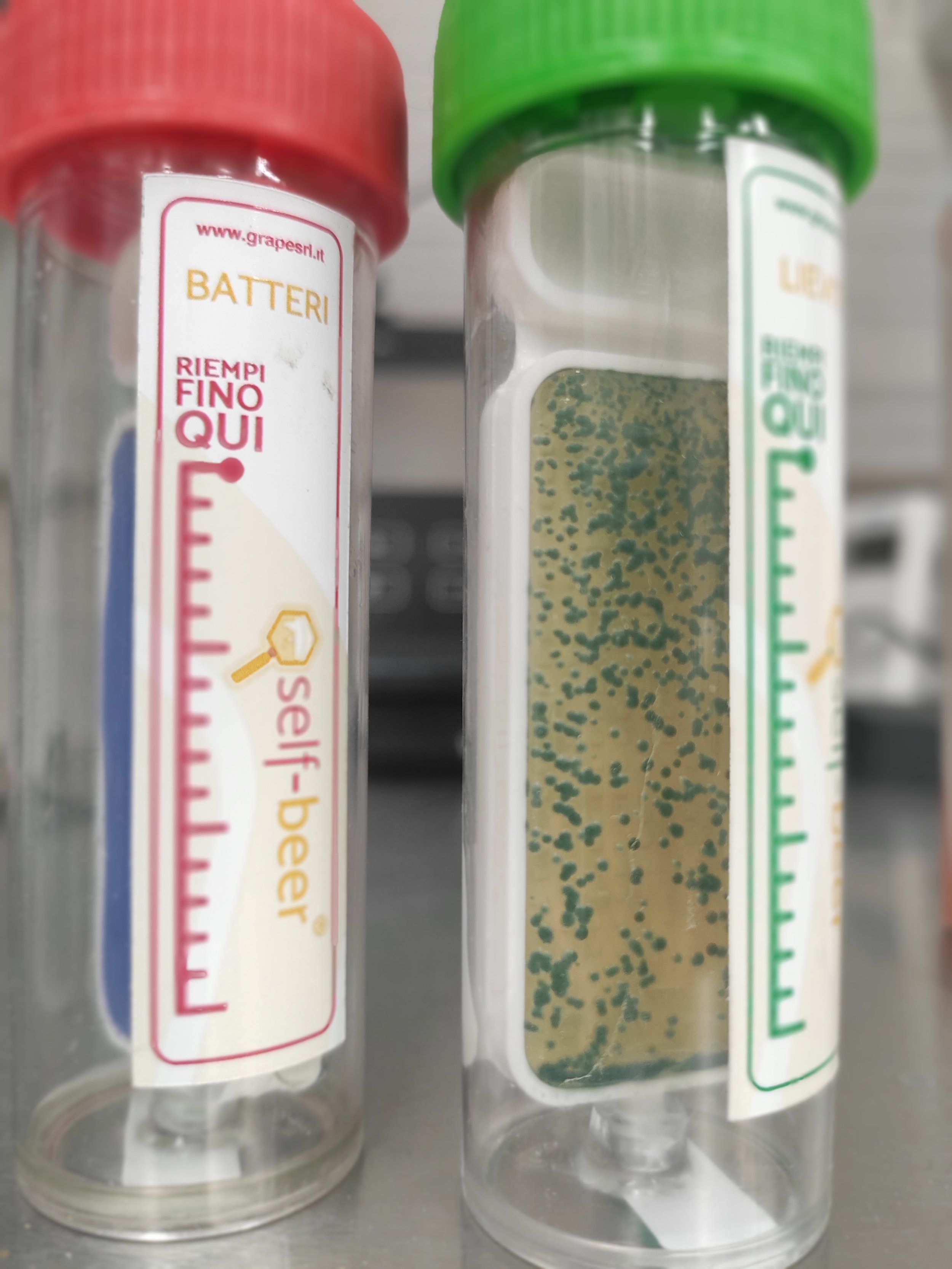 Image 2 of 2
Advantages:
Ease of use: Self-Beer® can be used directly at the production site without the need for laboratories or specialized personnel, ensuring clear results in every case
Clear result: The user can assess the presence of contaminating microorganisms by observing colony growth in the culture medium
Cost: lower than that of laboratory tests
Composición y aplicaciones del kit:
Evaluación de la presencia de contaminación por levaduras salvajes, bacterias lácticas y bacterias acéticas. También puede evaluarse la viabilidad de las levaduras Saccharomyces. El kit Self-Beer® consta de dos tubos de ensayo, uno verde y otro rojo. El tubo con el tapón verde permite el análisis de levaduras: en el lado A crecen levaduras totales, mientras que en el lado B crecen levaduras no-Saccharomyces (levaduras salvajes). El tubo de ensayo con tapón rojo permite el análisis de bacterias: en el lado A crecen bacterias acéticas, mientras que en el lado B crecen bacterias lácticas.


Instructions and Recommendations for Use:
Unscrew the caps and place them upside down, being careful not to touch the agar medium.
Fill with the liquid to be tested up to the mark indicated on the label
Shake gently and wait 60 seconds
Empty it out and let it drain on a paper towel
Close the container and let it sit at room temperature (18–30 °C) for 3–5 days
Observe the result obtained (without the need for microscopes or magnifying glasses)
Self-beer® is designed for use in breweries under normal operating conditions. However, certain precautions and best practices for sampling are recommended, such as:
• sanitize the sampling nozzles
• Pour out a small amount of the disposable product before filling the Self-beer®
• If necessary, use thoroughly disinfected jars or containers during certain stages of sampling
• Avoid keeping Self-beer® open any longer than necessary to fill and empty it
• Do not touch the agar medium or the inside of the tubes with your hands
Choosing the wrong sampling stage can lead to unreliable results; in particular, sampling during vigorous fermentation—whether in the tank or in the bottle—should be avoided. In the case of refermentation, sampling should be performed immediately before adding yeast or once the product has stabilized. For more information, please contact us.
Interpretation of the results:

If the sample being tested is contaminated, after 3–5 days at room temperature (18–30 °C), colonies (visible as spots of various sizes and colors) will be visible on the surface of the agar medium. On side A of the green test tube and on side B of the red test tube, a color change to yellow will also be visible in the event of microbial growth. Contamination Assessment: If the sample is positive, the extent of contamination can be assessed semiquantitatively by observing the number of colonies on the agar.
Conservation:
10–25°C, away from sources of light or heat, until the expiration date indicated on the outside of the box.
Expiration:
The minimum shelf life is 12 months from the date of manufacture. Because this is an agar-based gel, the product may undergo evaporation and natural weight loss depending on seasonal weather conditions and storage/transport conditions.
Quality Control:
Each batch of SelfBeer® is tested using the following strains:
DSM 70451 Saccharomyces cerevisiae Green Cap Side A
DSM 2548 Saccharomyces pastorianus Green Cap Side A
DSM 21959 Pichia membranifaciens Green Cap Side B
DSM 2002 Acetobacter aceti Red Cap Side A
DSM 20019 Lactobacillus curvatus Red Cap Side B